

Static Fear
Part 2

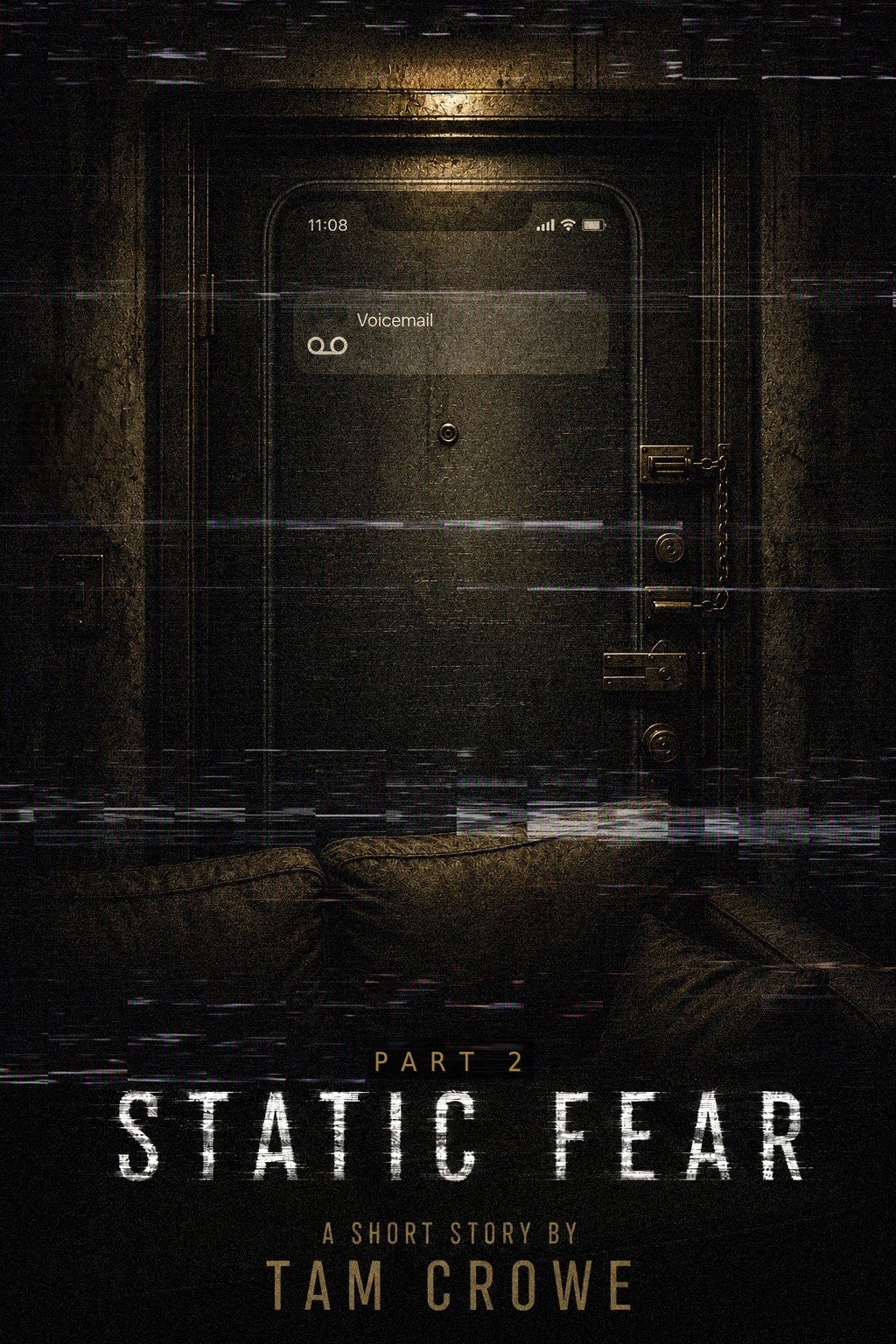
PART 2
By morning, the work orders are still waiting.
Building C stairwell light. Disposal in 1C. Vent outside 2A.
Normal problems.
I stand by my front door with my keys in one hand and my phone in the other. My tool bag sits on the floor waiting. I know the order I should do things. I know how the day is supposed to go.
Then a dry, dead radio hiss comes through the kitchen vent. I look back at it, then at the door. For a minute, I don’t open it. That bothers me more than the sound. I’ve opened this door half-asleep, carrying groceries, holding coffee, dragging trash bags, answering tenant calls at two in the morning. My door. My lock. My hallway. There shouldn’t be anything on the other side that makes my hand stop before it touches the knob.
I make myself turn it.
The breezeway is empty at first glance. Wet concrete, yellow light, stairs at the far end. I lean out just enough to see past the rail, and something moves at the corner near the stairwell. Not a person. Not exactly. More like the space where a person had been standing a second before.
Then it’s gone.
Standing there with the door half-open, keys biting into my palm, the feeling of being watched comes over me so hard I almost step back without meaning to.
The corner near the stairwell stays in my sight longer than it should. Wet concrete. Rain smell. Yellow light trembling over the steps. The electrical buzz above my head, thin and steady.
Back inside, I shut the door and throw the deadbolt.
The work orders can wait. The stairwell light can blink. Mrs. Treadwell’s disposal can grind itself stupid a little longer. First, I need to figure out what’s happening here.
The keys go on the counter.
The notepad is still on the floor beside my toolbox, open to last night’s numbers. Door swing. Threshold. Ceiling. Frame.
Then I move the couch six inches, just enough to see how it’ll sit against the entry when I need it there.
A broom handle goes in the track of the sliding glass door. Empty cans line up along the windowsills. Not many. Just enough that I’ll hear them if the window moves.
Sometime after dark, I sit on the floor by the front door and take the knob apart to fix the loose play in it.
The screws come out, the plate comes loose, and the latch’s guts sit exposed in the door like ribs showing. My toolbox is open beside my knee. I clean out the old grit, tighten what needs tightening, and then keep going after the repair is done.
The message keeps turning in my head: in danger, coming to, door.
I use whatever my hands find in the toolbox, the kind of odds and ends I keep because throwing away useful things feels wrong. By the time I’m finished, the knob turns clean from my side. From the other side, something in the hardware catches if the knob is forced.
That should be enough, but I keep looking at the ceiling above the entry. I get the sledge from the closet where I keep the bigger tools, the one for busted concrete and stubborn posts. It feels too heavy in my hands. That’s why I don’t put it back.
I open the door and step into the breezeway to check my work from the outside. The air smells like rain and old concrete. I look at the knob, the frame, the space above it, the angle back into my apartment. I test nothing hard enough to set anything off. Just enough to know it’s there.
Good.
I step back inside, shut the door, throw the deadbolt, set the chain. Then I drag the couch into place against the entry, the legs scraping softly over the floor until the armrest sits where I want it.
My phone is on the kitchen counter. I haven’t touched it in hours.
The screen lights up with one new voicemail.
I get up too fast, my knee popping as I cross the room. When I pick up the phone, my stomach tightens. Same message. Same blank caller. Same timestamp from yesterday. Same little play button waiting at the top.
I press play before I can talk myself out of it.
My own breathing fills the kitchen. My own voice says my name. My own warning comes through, small and scared.
“Dean, listen to me. You are—”
Static takes the rest.
I play it again, leaning close, trying to hear under the noise.
“—in danger—”
The words come through bent, broken.
“—coming to—”
Static cuts through the rest, then clears long enough for one last piece.
“Door.”
The message ends, but the static keeps going.
I lower the phone but don’t put it down. Across the room, the deadbolt shines under the light. The refrigerator clicks off, and the ordinary apartment sounds fall away until only that far-off electric noise is left.
A dry crackle comes from the vent above the stove. Another from the outlet behind the microwave. Then the wall beside the door gives off a low, steady band of white noise, like a dead radio playing somewhere inside the frame.
The phone is still in my hand. Everything else in the apartment feels built around it now: couch against the door, toolbox by the entry, windows covered.
I wake the screen.
The phone vibrates hard in my hand.
Once. Twice. Then again and again, fast enough I almost drop it. Notifications stack across the screen like they’ve been waiting somewhere else and found their way through all at once.
Six missed calls. Four from Hannah. Two from Lisa. Texts underneath them, none of them there when the voicemail lit the screen.
Dad, please answer.
Are you mad at me?
The last one came twelve minutes ago.
I’m scared.
I call her before I can make another excuse.
She answers halfway through the first ring. “Dad?”
“Hey,” I say. My voice sounds rough, so I clear my throat and try again. “Hey, kiddo. I’m here.”
“Why weren’t you answering?”
“The phone’s acting up. Messages coming in late. Calls not showing. Whole thing’s been stupid all day.”
“You scared me.”
“I know. I’m sorry.” I sit down hard in the kitchen chair, phone pressed tight to my ear. “I didn’t mean to.”
For a few seconds, I can hear her breathing. I picture her in her room with one of my old hoodies pulled over her knees, trying hard not to sound scared. She still leaves hoodies everywhere, still eats pizza crust first to irritate me, still thinks I don’t know when she’s trying not to cry.
“Are you okay?” she asks.
I look at the door. Couch braced against it, toolbox on the floor, deadbolt thrown, chain set, the knob I took apart. Above the entry, the sledge waits where I left it.
“I’m handling it,” I say.
“Handling what?”
The wall beside the door starts to buzz, low and steady. My mouth goes dry.
“Nothing. Just some stuff around the apartment.”
“What stuff?”
“Just stuff,” I say, and as soon as it’s out, I know it sounds wrong. “Lock’s loose. Frame’s old. You know how this place is.”
“You sound weird.”
“I’m tired.”
“Dad.”
“I’m fine, Hannah. Promise.” I lower my voice, like that can make the words come out normal. “It’s just the phone. Calls not showing, messages coming in late. You know how service gets around here.”
“So what’s wrong with it?”
“I don’t know yet.” I look toward the door before I can stop myself. “I’m working on it.”
“The phone?”
“Everything.” The word comes out too quick. I clear my throat. “I mean, a few things around the apartment. Lock’s been loose. Radio’s acting up. Old building stuff.”
“You don’t sound okay.”
“I said I’m tired.”
“Are you sure?”
The apartment gives another short burst of white noise, this time from behind the microwave. I turn toward it, and for a second I forget she’s still on the line.
“Dad?”
“I’m here.”
“You stopped talking.”
“Sorry. Thought I heard something.”
“What?”
“Just the building.” I rub my thumb along the edge of the phone. “Listen, I’m okay. I’ll call you in the morning.”
“You promise?”
“Promise.”
“Okay.”
She says it softly, like she wants to believe me.
“Love you, kiddo.”
“Love you too.”
The call ends. The kitchen feels worse without her voice in it.
For a while, I just sit there with the phone in my hand.
The minutes stretch out. The kitchen clock ticks past one hour, then another. I don’t turn on the television. I don’t eat. I don’t call her back. Every few minutes, the phone lights up with a text from Hannah or Lisa. Each one brings the noise up under it, soft at first, then louder.
Now, electric fuzz has settled into the apartment like bad weather. It’s everywhere. In the walls. Behind the outlets. Buzzing through my head.
It’s a little past midnight, and the apartment feels smaller than it did before.
I keep trying to remember when being afraid of my own door started making sense.
That’s the part I can’t wrap my head around. Not the voicemail. Not the sound in the walls. The door. My door. I know every screw in it. Every gap in the frame. Every little squeak it’s made over the years.
Now I’m sitting across from it like it might open its mouth.
I tell myself I’m being careful. Careful is good. It keeps pipes from bursting, wires from burning, and people from getting hurt.
But there’s careful, and then there’s this.
This feels like something I should be able to stop.
I look over at the phone.
That’s where it started. The voicemail came through there. The static came through there. Every bad sound since then has led me back to that little black screen.
I stand up, cross the kitchen, and pick it up. My hand is steady at first. That seems worth noticing.
I open the voicemail and press play. The breathing starts; my own voice says my name, but I don’t let it finish. I set the phone on the floor, take the hammer, and bring it down hard enough to crack the screen. The second hit caves the face in. The third knocks something loose inside, sends it skittering across the floor. I hit it again. Stopping too soon is how bad parts stay bad.
Then I stop. The apartment is silent, and I stand over the broken phone with the hammer in my hand, breathing hard.
There. Fixed. For a second, I believe it.
The apartment sounds like itself again. Like it did before the message. Rain on the window. Refrigerator low in the kitchen. A car moving through the lot. Normal sounds. I almost laugh.
Then every speaker in the apartment pops at once.
The dead television cracks loud enough to make me step back. The radio on the counter spits white noise through its little plastic grille. My laptop chimes from the bedroom, then hisses. The smoke detector gives one sharp chirp and breaks into an electric scream. Even the busted phone at my feet starts ticking from inside its cracked shell, small and fast beneath the broken glass.
Static pours through everything with a speaker, a wire, a battery, a circuit. It fills the kitchen, spills down the hall, and runs behind the walls until the whole apartment sounds tuned to the same dead channel. I clamp both hands over my ears, but the sound gets in anyway. It buzzes in my teeth. It shakes the plates in the cabinet. Even the rain on the window starts to sound like static.
I look down at the broken phone. The screen is black, the body cracked open, but a voicemail alert rings from inside it, clean and bright under all that noise.
My hand goes cold around the handle of the hammer.
The alert rings again.
The broken phone lies in pieces on the floor, screen black except for the voicemail icon glowing through the cracks.
I get down on one knee.
Static runs through the apartment in waves. It moves through every place I checked, every place I sealed, every place I thought I understood.
The voicemail starts playing by itself.
At first there is only static. Thick. Close. Loud enough to make my teeth ache.
Then my voice comes through, quieter this time, tired enough to make my stomach turn. “Dean, listen to me. Y—” An electric crackle rips through the message before the word can finish. I lean closer, one hand braced on the counter, the broken phone ticking softly on the floor beneath all that noise.
“Hannah.”
The message breaks apart again.
For a second, I don’t move. Then I look at the door, the couch jammed in front of it, and all the separate pieces I put there become one thing.
The knock comes while I’m still staring at the door.
Three soft hits, close together.
My whole body goes cold.
“Dad?” Hannah says from the other side. Her voice is muddled through the wood, scared and real and close enough to touch. “Please open the door.”
I move before I think. The chair catches my hip, the table rocks, and broken glass from the phone bites into my palm when I push myself up. I barely feel it. All I can see is the door, the couch jammed in front of it, the toolbox beside the armrest, the chain, the deadbolt, the knob I took apart and put back together wrong on purpose.
“Hannah,” I say, but my voice comes out too small.
The knob turns.
For one clean second, I understand enough of the warning. Hannah’s name in the static. The door. The trap. The hidden catch I built because I thought something was coming for me.
“Hannah, don’t touch—”
The catch releases the hook, and the twenty-pound sledge swings down from the ceiling. The sound on the other side is small, soft, and final.
The noise cuts out.
I stand with both hands on the couch, staring at the door I fixed, the door I strengthened, the door I turned into the only thing between me and the person who came to save me.
A dark line seeps under the threshold.
At first, I don’t understand what I’m looking at. Then it widens against the floor, slow and red and real.
From the floor behind me, the broken phone clicks once.
The voicemail plays again.
No static this time.
My own voice fills the apartment, tired and close and too late.
“Dean, listen to me. You are not in danger. Hannah is. She’s coming to check on you. Do not rig the door. The trap is going to kill her.”
The message ends. I stay where I am, one hand on the couch, the other pressed against the floor, staring at the door while Hannah’s name sits in my mouth with nowhere to go.
T.C. 7.7.2026
